BJT Transistor Working Principles, Characteristics, & Switching
Bipolar Junction Transistors (BJTs) are fundamental components in modern electronics, playing a crucial role in amplification and switching applications. Understanding their working principles, characteristics, and the design of switching circuits is essential for engineers, technicians, and DIY enthusiasts alike. This guide will provide a comprehensive overview of BJTs, including their operation, practical applications, and considerations for safe and compliant circuit design.
Working Principles of BJT Transistors
What is a BJT?
A Bipolar Junction Transistor (BJT) is a semiconductor device that can amplify or switch electronic signals. It consists of three regions: the emitter, base, and collector, which form two pn junctions. BJTs can be categorized into two types:
- NPN Transistor: Composed of two n-type semiconductor materials separated by a p-type material.
- PNP Transistor: Composed of two p-type semiconductor materials separated by an n-type material.
How Does a BJT Work?
The operation of a BJT relies on the movement of charge carriers (electrons and holes). Here’s how it functions:
-
Biasing: For a BJT to operate, it must be properly biased. In an NPN transistor, the base-emitter junction is forward-biased, while the base-collector junction is reverse-biased.
-
Current Flow:
-
When a small current flows into the base (IB), it allows a larger current to flow from the collector to the emitter (IC).
-
The relationship between these currents is defined by the transistor’s current gain (β or hFE), given by:
I_C = β × I_B
-
-
Amplification: As a result, a small input current can control a much larger output current, enabling amplification.
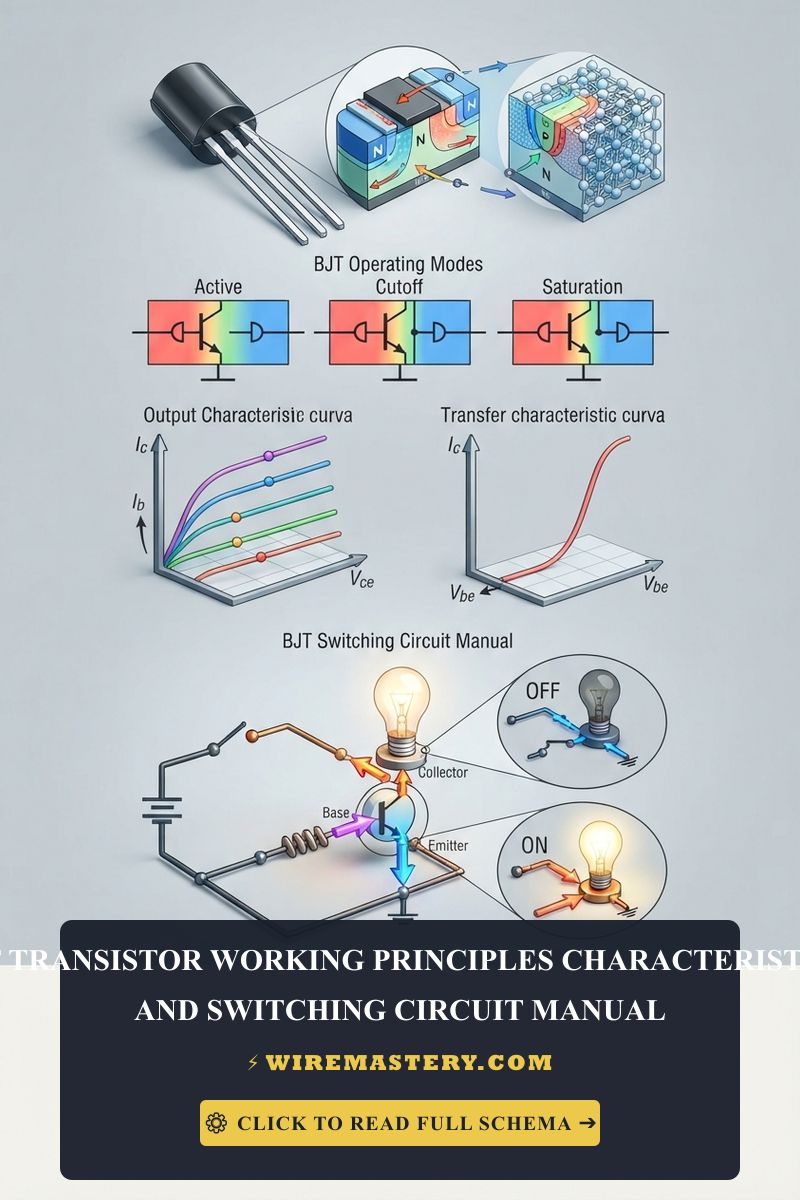
BJT Operating Regions
BJTs operate in three distinct regions:
- Active Region: The transistor is used for amplification. The base-emitter junction is forward-biased, and the collector-base junction is reverse-biased.
- Cut-Off Region: The transistor is turned off. Both the base-emitter and collector-base junctions are reverse-biased, leading to minimal current flow.
- Saturation Region: The transistor is fully on. Both junctions are forward-biased, allowing maximum current flow.
Key Characteristics of BJTs
Current-Voltage Characteristics
The characteristics of a BJT are typically represented in a graph showing the relationship between the collector current (IC) and the collector-emitter voltage (VCE) for different base currents (IB). Key points include:
- Cut-Off Region: IC is approximately zero.
- Active Region: IC varies linearly with IB.
- Saturation Region: IC approaches its maximum value, and VCE drops close to zero.
Parameters
- DC Current Gain (β): The ratio of collector current to base current.
- Collector-Emitter Saturation Voltage (VCE(sat)): The voltage drop across the collector-emitter junction when the transistor is in saturation.
- Base-Emitter Voltage (VBE): Typically around 0.7V for silicon transistors when forward-biased.
Switching Characteristics
BJTs can function effectively as switches in various applications. Here’s a detailed description of their switching characteristics:
Switching Times
- Turn-On Time (tON): The time taken for the transistor to switch from the cut-off region to the saturation region.
- Turn-Off Time (tOFF): The time taken for the transistor to switch from saturation back to cut-off.
These switching times are influenced by:
- Base current magnitude
- Load conditions
- Device capacitance
Switching Circuit Design
Designing a switching circuit with BJTs involves several steps:
- Select the BJT: Choose a transistor based on required current and voltage ratings.
- Calculate Biasing Resistors: Use Ohm’s law and the transistor’s parameters to determine appropriate resistor values for base biasing.
- Design Load Circuit: Ensure the load is compatible with the transistor’s specifications.
- Include Protective Components: Such as diodes to prevent back EMF in inductive loads.
Tools and Materials Required
To work with BJTs, you will need the following tools and materials:
Essential Tools
- Multimeter: For measuring voltage, current, and resistance.
- Soldering Iron: For assembling circuit components.
- Breadboard: For prototyping circuits without soldering.
- Wire Strippers: To prepare wires for connections.
- Oscilloscope: For analyzing the switching behavior of the circuit.
Recommended Wire Gauges
- For low-current applications (up to 1A): Use 22 AWG wire.
- For medium-current applications (1A to 5A): Use 18 AWG wire.
- For high-current applications (5A and above): Use 14 AWG wire or thicker.
Practical Applications of BJTs
BJTs are utilized in various applications, including:
- Amplifiers: Audio and radio frequency amplification.
- Switching Circuits: Power switching in relays and motor control.
- Signal Modulation: In communication systems for modulating signals.
Safety Checklist
When working with BJTs and electronic circuits, follow these safety guidelines:
- Power Off: Always ensure that power is off before making or changing connections.
- Use Insulated Tools: This reduces the risk of electric shock.
- Verify Ratings: Ensure components are rated for the expected voltage and current.
- Check Connections: Inspect all connections before powering up the circuit.
- Avoid Overheating: Use heat sinks on BJTs as necessary to prevent thermal damage.
NEC Compliance & Official Safety Standards
Adhering to the National Electrical Code (NEC) is essential for ensuring the safety and reliability of electrical installations. The NEC sets standards for electrical wiring and equipment, providing guidelines to prevent hazards such as fire and electric shock. Compliance with these regulations is not just a legal obligation but also a critical aspect of maintaining safety in residential settings.
By following the NEC guidelines, electricians and contractors can protect themselves, their clients, and the structures they work on from electrical hazards. For more information on current NEC requirements, please refer to the Official NFPA 70: National Electrical Code (NEC).
Conclusion
Understanding the working principles and characteristics of BJTs is vital for anyone involved in electrical engineering or electronics. With their versatility in amplification and switching applications, BJTs remain integral to modern electronic designs. By following proper guidelines and ensuring compliance with safety standards, you can effectively utilize BJTs in your projects while maintaining safety and reliability. Always remember to stay informed about the latest regulations and best practices to ensure the highest standards of electrical safety.