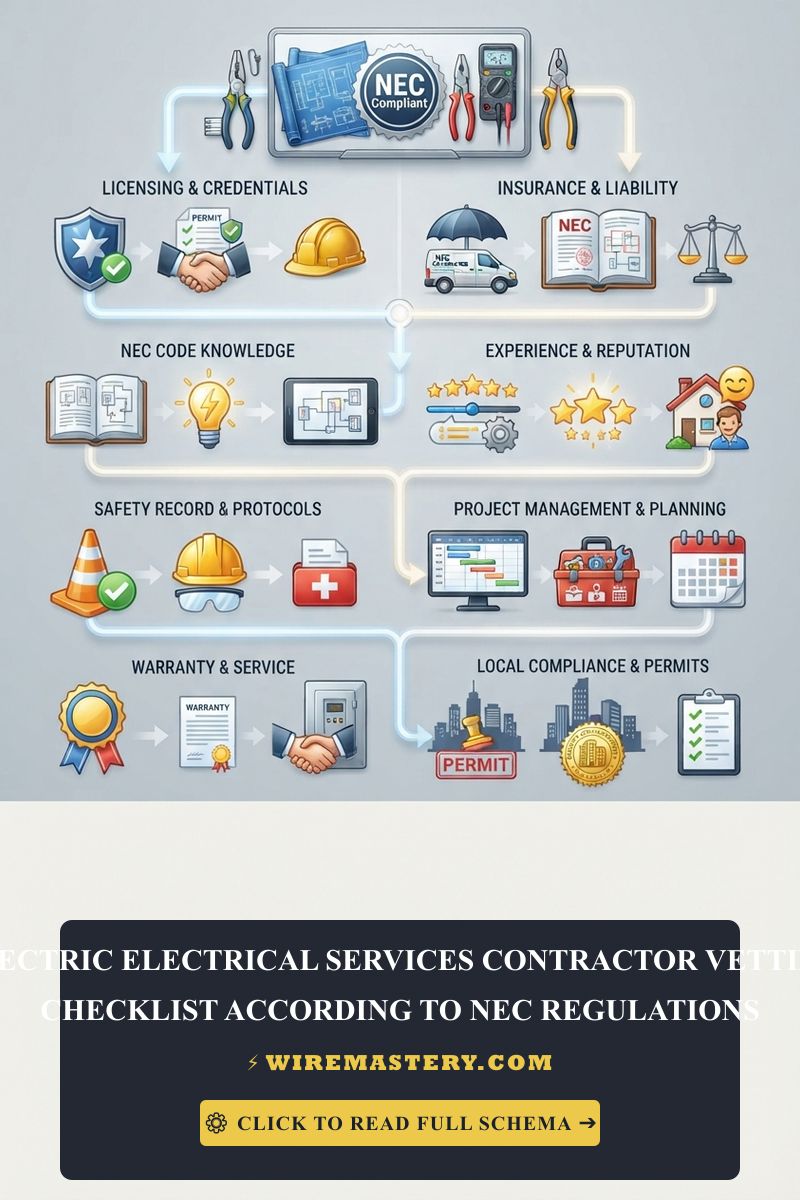
Electrical Contractor Vetting: NEC Compliance Punch List
Executing a professional, code-compliant field audit to vet a residential electrical installation before scheduling a formal municipal inspection demands a rigorous, disciplined command of National Electrical Code (NEC) workmanship standards, terminal torque parameters, and structural spatial boundaries. In North American residential construction frameworks, passing an electrical inspection requires looking past basic operational component checks. Hired contractors must deliver an infrastructure layout that satisfies the strict legal mandates of NEC Article 110, which dictates that all electrical work must be executed in a neat and workmanlike manner. Utilizing sloppy wire routing loops, failing to use calibrated fastening instruments, or compressing high-density conductor bundles into tight wall cavities will trigger an immediate structural project shutdown by the local Authority Having Jurisdiction (AHJ).
This inspection manual outlines the definitive field punch list required to audit specialty trade sub-contractors, verify system bonding geometries, and evaluate advanced trade instrumentation.
Core Quality Control Audit Parameters
Before signing off on contract milestone payments or authorizing final drywall closure steps, the inspector or project manager must enforce these three structural benchmarks:
- The Mechanical Workmanship Clause (NEC 110.12): Electrical conductors and equipment must be installed in a neat and workmanlike manner. Unused openings inside plastic or metallic gang boxes must be physically sealed with listed closure plugs, all Romex cable sheaths must be routed straight and flat parallel to structural framing studs, and cables must be secured tightly within 12 inches of every enclosure box.
- The Component Listing Mandate (NEC 110.3(B)): Every single hardware asset integrated into the building envelope—including the overcurrent circuit breakers, duplex receptacles, low-voltage control modules, and conduit joints—must be officially listed and labeled by an independent testing laboratory (such as UL, Intertek, or CSA) and installed strictly in accordance with the manufacturer’s printed instructions.
- The Neutral Separation Prerequisite: Downstream of the primary service entrance panel board enclosure, the grounded neutral conductors (White) must remain entirely isolated from the equipment grounding conductor rails. Tying or wire-nutting neutrals and grounds together inside a local subpanel gutter or room junction box induces dangerous ground loop current paths, violating federal inspection codes.
Technical Materials & High-Energy Contractor Field Auditing Toolkit
To effectively execute a pre-inspection walkthrough and verify that your hired trade crew maintains absolute structural precision across live panels, utilize this certified asset matrix:
| Industrial Auditing Instrument | Primary Engineering Purpose & Safety Verification Metric |
|---|---|
| Calibrated Dial Torque Wrench | Absolute legal requirement to tighten circuit breaker terminal lugs to exact inch-pound specs. |
| True RMS CAT IV Clamp Ammeter | category CAT IV 600V certified to safely capture continuous service entrance currents. |
| Digital Megohmmeter (Megger) | Injects a high-voltage DC potential to audit line conductor insulation shielding integrity. |
| Three-Wire GFCI Loop Analyzer | Plugs directly into finished ports to verify circuit polarity and inject 5 mA fault simulations. |
| Personal Protective Equipment (PPE) | Insulated work gloves, hard hats, and high-impact ANSI-rated polycarbonate goggles. |
Conductor Overcurrent Headroom & Wire Gauge Boundaries
A primary focal point of the municipal inspector’s audit path is verifying that the installer matched all conductor cross-sectional diameters directly to the primary circuit breaker rating in strict compliance with NEC Article 310.16:
- 14 AWG Solid Copper Conductor (15-Amp Protection Limit): Standard white protective insulation jacket profile. Sized exclusively for low-density residential lighting runs and standard bedroom convenience outlets.
- 12 AWG Solid Copper Conductor (20-Amp Protection Limit): Heavy-duty yellow protective insulation jacket profile. Mandatory for high-draw residential nodes under continuous loading, including kitchen small appliance branch circuits (SABC) and bathroom vanity plugs.
- 10 AWG Solid Copper Conductor (30-Amp Protection Limit): Orange jacket sheathing. Required for heavy continuous loads such as dedicated electric water heaters and central air conditioning compressors.
Technical Phase 2: The Definitive Pre-Inspection Field Punch List
To guarantee your hired trade crew passes the municipal code enforcement audit on the first walkthrough, execute this systematic, multi-point physical punch list across all finished junction and panel enclosures:
1. Itemized Code Compliance Walkthrough Matrix
| Junction Enclosure Zone | Mandatory NEC Code Reference | Physical Verification & Audit Metric |
|---|---|---|
| Terminal Fastener Lugs | NEC 110.14(D) | Verify screw lugs are torqued with a calibrated wrench to exact manufacturer inch-pound specs. |
| Panel Working Space | NEC 110.26 | Maintain a strict clear envelope of 36” depth and 30” width front clearance. |
| Conductor Box Fill | NEC 314.16 | Verify high-density boxes are not overcrowded, allowing 2.25 cu in per #12 AWG line. |
| Circuit Directories | NEC 408.4 | Enforce permanent, highly legible, explicit room labels on the panel door faceplate. |
| Receptacle Shutters | NEC 406.12 | Confirm all general-use convenience outlets incorporate certified Tamper-Resistant (TR) slots. |
| Grounding Electrode | NEC 250.50 | Audit continuous bonding to dual 8-foot earth rods and the metallic water main. |
2. The Critical Torque Calibrations Mandate (NEC 110.14(D))
The single most frequent electrical workmanship failure flag raised by city inspectors is un-calibrated wire connections. Aluminum and copper conductors expand and cold-flow under continuous seasonal loading cycles. If the sub-contractor tightened the main lugs or branch circuit breakers using standard manual screwdrivers by “feel,” the connections will loosen over time, creating a high-resistance arc fault hotspot. Hired contractors must deploy a calibrated dial torque wrench to secure all panel lugs to exact factory engineering specifications stamped on the device mold (typically 35 to 45 inch-pounds for branch lines and 250 inch-pounds for main service feeds), preventing localized thermal insulation melting. To cross-verify the precise terminal mechanics required to pass these audits, map your progress against our master structural blueprint on miniature circuit breaker installation and working principles.
🛠️ The Anti-Oxidant Interface Requirement Note: Look closely at the split-phase service entrance layouts showcased across our master electrical portfolios. Notice that if your property addition or service upgrade utilizes high-capacity aluminum feeder conductors rather than copper, building codes strictly mandate stripping the wire shanks and packing the raw strands with a certified zinc-based anti-oxidant joint compound before inserting them into the terminal pressure plates. Bypassing this chemical barrier allows galvanic atmospheric oxidation to pit the terminal interfaces, inducing massive voltage drops and chronic thermal expansion failures.
Troubleshooting Severe Pre-Inspection Field Failures
- The Contractor Installed Standard Outlets Within 6 Feet of the Bathroom Sink: This is a critical personnel shock safety code violation. Under the mandates of NEC 210.8(A), all convenience receptacles located near high-moisture fluid boundaries must incorporate active Class A ground-fault circuit interrupter protection. Force the contractor to tear out the standard yokes and install certified Tamper-Resistant GFCI modules before requesting a city inspection. For the explicit wiring diagrams needed to fix these zones, follow our forensic manual on GFCI outlet bathroom code requirements and 20A branch guides.
- The Newly Reset Arc-Fault Breakers (AFCI) Trip Instantly Upon Panel Initialization: An absolute indicator of an active downstream ground-to-neutral wire pinch executed during the structural rough-in phase. When high-density conductor bundles are packed into a tight gang cavity, a drywall screw can pierce a Romex sheath or an uninsulated bare copper ground wire can touch a silver neutral terminal screw. While vintage panels were completely blind to micro-ampere leaks, modern AFCI chips will drop the branch offline in milliseconds. Force the crew to run unpowered resistance continuity tests to isolate the short circuit box by box.
- The Main Panel Gutter Houses Illegal “Double-Stabbed” Lug Terminations: This occurs when a perezoso installer jams two independent branch hot wires beneath a single circuit breaker screw plate designed for one wire. Under active overcurrent protective regulations, this creates high-resistance gaps as the wires fight for compression. Every individual conductor must land on its own assigned terminal lug port to satisfy federal inspection parameters.
National Electrical Code Subpanel Workspace Regulations
Adhering to strict national installation codes protects your home automation investments from hidden hazards, ensures full property valuation, and guarantees full property insurance compliance. The National Electrical Code strictly regulates residential switchboards, workspace clearances, and device grounding integrity under NEC Article 110 (Requirements for Electrical Installations) and Article 408 (Switchboards and Panelboards):
- The Clear Working Space Mandate (NEC 110.26): Main circuit breaker panels, distribution centers, and relocated subpanel gutters must maintain an absolute, un-obstructed physical clear working area of at least 3 feet (36 inches) of front depth clearance and 30 inches of flat width clearance from the deadfront shield. This spatial envelope must extend from the finished floor plane up to a minimal height of 6.5 feet, ensuring field service technicians maintain ample free breathing space to access components safely.
- The Prohibited Location Rule (NEC 240.24): Circuit breakers and service panels are strictly prohibited from being located inside residential clothes closets packed with easily ignitible fabrics, or within high-moisture residential bathrooms, preventing immediate component corrosion and arc-flash fire escalation hazards.
For the NFPA 70 provisions relevant to this guide on Electrical Contractor Vetting: NEC Compliance Punch List, consult the Official NFPA 70: National Electrical Code (NEC).
Conclusion
This guide covers executing rigid NEC Article 110 workmanship audits, enforcing itemized pre-inspection punch lists, and validating terminal lug pressure plates using calibrated dial torque wrench settings transforms volatile home renovations into highly predictable, residential engineering operations. By keeping branch conductor gauges fully aligned with NEC Article 310.16 overcurrent charts, eliminating dangerous ground-neutral cross-connections, and respecting mandatory NEC workspace spatial envelopes, you construct an unshakeable, exceptionally resilient residential grid infrastructure. For final checks, complete panel breaker power isolation safety checkups before raw line handling, deploy CAT III certified multimeters, and complete every diagnostic walkthrough step with precision.